






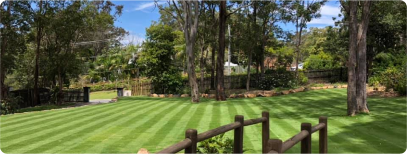

If your mower has spent most of winter sitting in the shed, it’s probably time to dust it off.
Spring is here in Southeast Queensland, and with warmer days and increasing soil temperatures, our warm-season grasses are starting to wake up. That means the lawn that only needed an occasional mow through winter can suddenly start growing a whole lot faster.
And while regular mowing is one of the simplest things you can do for a healthy lawn, how you mow matters just as much as how often you do it.
Here’s how to get your mowing routine back on track this spring.
Why your lawn starts growing faster in spring
Southeast Queensland has a pretty forgiving climate for warm-season turf. Unlike colder parts of Australia where lawns can go completely dormant through winter, our turf generally keeps ticking along, just at a much slower pace.
As the days get longer and temperatures rise through September and October, varieties like Sir Walter DNA Certified Buffalo, TifTuf Bermuda, Nullarbor Couch, Sir Grange Zoysia and Zoysia Australis begin responding to those warmer conditions.
That means more growth, more mowing and, if you're not careful, the occasional lawn that gets away from you.
The good news? Getting back into a regular mowing routine now will make the rest of spring and summer much easier.
Start with a mower check
Before you head straight into the backyard, give your mower a once-over.
After sitting around for a few months, it’s worth checking:
- Are the mower blades sharp?
- Is the mower cutting evenly?
- Is the catcher or mulching deck clean?
- Is the mower running properly?
- Is the mowing height set correctly for your turf?
Sharp blades are particularly important. A clean cut puts less stress on the grass and helps it recover quickly, whereas a blunt blade can tear the leaf and leave the lawn looking ragged.
It’s a small job now that can save you plenty of frustration once your lawn really starts moving.
Don't wait until the lawn gets out of hand
One of the biggest mowing mistakes is leaving the lawn too long between cuts and then trying to take it right back down in one go.
We get it. Life gets busy.
But unfortunately, your lawn doesn't particularly care about your weekend plans.
The golden rule is never remove more than one-third of the leaf blade in a single mow. If your grass has grown well above its normal height over winter, bring it down gradually over a couple of cuts rather than scalping it in one hit.
Once spring growth really kicks in, regular mowing is much easier on the lawn than letting it get long and giving it a major haircut every few weeks.
Know your turf's preferred mowing height
Not every lawn should be mowed the same way.
Your ideal mowing height depends on the turf variety, and keeping your mower at the right height helps the lawn maintain good density, recover from mowing and handle the conditions ahead.
As a general guide for Southeast Queensland:
|
Turf variety |
Approx. mowing height |
|
Sir Walter DNA Certified Buffalo |
40–60mm |
|
TifTuf Bermuda |
15–25mm |
|
Nullarbor Couch |
15–25mm |
|
Sir Grange Zoysia |
25–40mm |
|
Zoysia Australis |
15–40mm |
These ranges give you a useful starting point, but your lawn's individual conditions matter too. Shaded areas, for example, generally benefit from being kept a little higher because the extra leaf area helps the grass make the most of the sunlight available.
More mowing doesn't necessarily mean more work
As spring progresses, you might notice your mower coming out more often.
That's completely normal.
Some varieties are naturally faster growing than others. TifTuf Bermuda and Nullabor Couch, for example, are vigorous growers that can require frequent mowing during the warmer months. TifTuf's ideal mowing height is around 20–40mm, with weekly mowing recommended through its peak growing period.
On the other hand, Sir Grange Zoysia has a much slower growth habit and can require significantly less mowing than many common turf varieties.
So don't judge your mowing routine by your neighbour's lawn. The right frequency for your backyard depends on your turf variety, weather, sunlight, watering and how quickly your lawn is growing.
Don't mow wet grass
Spring in Queensland can bring plenty of moisture, whether that's morning dew or an afternoon shower.
As tempting as it can be to get the job done anyway, it's best to wait until the grass is dry.
Wet grass doesn't cut as cleanly, can clump together and can make the mowing process harder on both your lawn and your mower. Our advice, wait until the morning dew has dried and avoid mowing straight after rain.
A dry morning or afternoon, outside the hottest part of the day, is generally a much better time to mow.
What about scalping?
You'll sometimes hear about scalping as a spring lawn-care technique, particularly with Couch, Bermuda and Zoysia varieties.
Done correctly, a carefully timed spring renovation can help remove excess material and encourage fresh growth. But scalping isn't something you should automatically do to every lawn, and it needs to be appropriate for the turf variety and its condition.
For example, we do recommend careful spring scalping or dethatching for varieties such as Couch, TifTuf and Zoysia, while Buffalo needs considerably more care because aggressive scalping can damage the plant.
If you're not sure whether your lawn needs it, it's better to ask before dropping the mower to its lowest setting.
Spring is also a good time to look at the lawn itself
Your first few spring mows are a good opportunity to assess how your lawn has come through winter.
Take a look at:
Bare or thin patches? These could be caused by shade, wear, weeds, pests or other underlying issues.
Excess thatch? A thick layer of thatch can affect water and nutrient movement into the soil.
Uneven growth? Different parts of the yard may be receiving different amounts of sunlight or water.
More weeds appearing? Spring is when weeds can quickly take advantage of thin or stressed areas of turf.
If your lawn is struggling despite your best efforts, the problem may not be your mowing routine. Sometimes the variety simply isn't suited to the conditions it's growing in.

A good spring mowing routine starts now
You don't need to make lawn care complicated.
Get your mower ready, set the right mowing height, keep the blades sharp and start mowing regularly as your lawn's growth increases. Most importantly, don't take shortcuts by cutting too much off at once.
Spring is one of the best times of year to get your lawn growing strongly in Southeast Queensland. With the right mowing routine, you'll help it build density and resilience before the heat, humidity and heavy backyard use of summer arrive.
And if you're finding that your current lawn isn't quite keeping up with what your backyard demands, it might be time to look at your turf variety.
At Jimboomba Turf, we've been growing premium warm-season turf for Southeast Queensland since 1973. From family-friendly Sir Walter Buffalo to hard-wearing TifTuf Bermuda, fine-leaf Nullarbor Couch and low-maintenance Sir Grange Zoysia, we can help you work out what will perform best in your backyard.
Ready to get your lawn growing? Get in touch with the Jimboomba Turf team for advice on choosing and caring for the right turf for your Queensland yard.


